

















The Sprinkler Company Inc. / French Drain in Clay Soil
Does a French Drain Work in Clay Soil?
A French drain in clay soil can carry collected water through a pipe, but it does not make the surrounding soil freely draining. A suitable outlet remains essential.
French Drain in Clay Soil: the direct answer
A French drain can convey water collected in its trench through a pipe. It does not make the surrounding clay freely draining or guarantee that distant wet areas connect to the trench.
Map where the wet ground lies relative to the proposed collection line. The filter must suit the soil and the outlet must remain functional. Where water mainly travels across the surface, grading or an inlet may be part of the solution. Ask how the proposal collects the actual water source, rather than assuming that more gravel anywhere in the yard will dry the entire property.
Clay-soil drainage option finder
Suggested next steps based on your answers; not an on-site diagnosis. NDS drainage maintenance
Choose the water problem before choosing the product
A drainage proposal should identify the source of the water, the route it will follow and a suitable discharge point. A line on a sketch is not proof that a gravity outlet exists. Ask for the proposed elevations and the part of the yard the system is intended to serve. Surface runoff and water moving through soil may require different collection methods.
A jar test or a single observation is not a substitute for a drainage design.
Technical reference: NDS: French drain installation guidance; Ontario Dig Authority: locate information. Site-specific product instructions and local requirements take precedence over an illustrative calculation.
Look for the water connection through the clay
A drainage trench only collects water that can reach its collection zone. Ask how the wet ground is connected to the proposed route rather than assuming that a pipe dries every point within a fixed distance. Surface movement, layers within the soil and the outlet can all affect the outcome. Clay conditions make this site-specific question more important, not less.
Follow the water from its source to its destination
A useful French-drain assessment starts before anyone chooses a pipe. Look at where water first arrives, the area that remains wet, and the lowest practical destination. Those are three different locations on many properties. Roof water may cross a dry part of the yard before collecting in a depression; seepage may emerge farther downhill. A trench placed only around the final puddle can miss the upstream cause. Photographs during rain, after rain and during dry weather help distinguish these patterns without disturbing the ground.
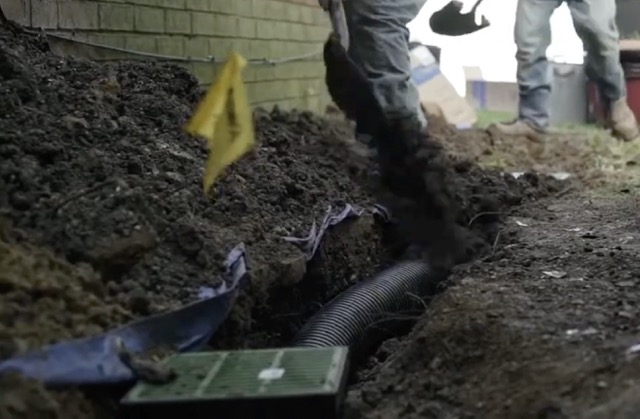
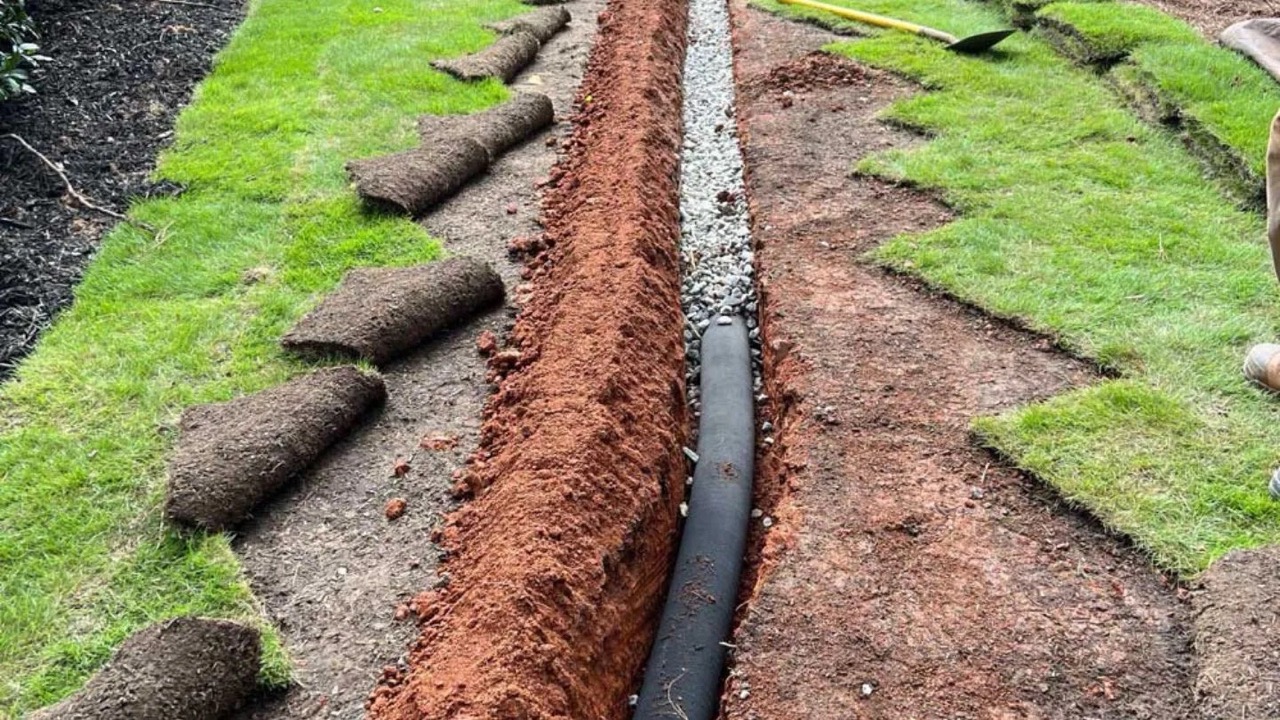
Surface collection and subsurface collection also need different descriptions in a proposal. Water crossing concrete must reach an inlet or channel before it can enter a buried pipe. Water moving through soil reaches a French drain through its filtered aggregate zone. A solid pipe is commonly used to carry collected water onward without intentionally collecting more along that section. Ask the contractor to identify these functions on the drawing. Calling everything a French drain can hide important differences in what the installation will actually do.
Compare complete drainage arrangements
A drain should be compared with other approaches using the same water problem. Changing surface levels can help an accessible low spot when there is a suitable runoff route. A channel may make sense at the edge of paving. An infiltration feature depends on soil and groundwater conditions, while a pumped arrangement introduces equipment and power requirements. None is automatically the cheapest or most reliable option for every address. The decisive question is whether the proposed arrangement collects the observed water and gives it somewhere appropriate to go.
The outlet deserves as much attention as the trench. Confirm its location, elevation and connection method before excavation. A pipe that reaches the edge of the property has not necessarily reached a permitted discharge point. A route can also have an overall downhill direction while containing individual low sections. Where there is no suitable gravity destination, simply digging a deeper or longer trench may not solve the problem. Discuss an alternative design instead of concealing the uncertainty beneath new turf.
Understand what the installation price includes
Published drainage prices describe a scope, not just a length of plastic. Site access, trench dimensions, material handling, soil disposal and final restoration can affect the work required. Keep the collection length separate from any solid outlet connection. Ask whether fittings, accessible cleanouts, outlet protection and the replacement of disturbed surfaces are included. A short route through a finished patio can require different labour from the same length across open lawn, even when the pipe product is identical.
Before work begins, resolve responsibility for locating utilities and privately owned services. Irrigation tubing, lighting cable and other site features may need separate identification. Agree where materials can be placed and how machinery will reach the route. Foundation excavation, unstable ground or deep trenches require appropriate professional planning; a homeowner guide is not an excavation safety plan. These questions are practical parts of comparing proposals, because omissions can otherwise become surprises after the garden has already been opened.
Keep a record that makes maintenance possible
Ask for photographs of the pipe route, fittings and accessible service points before the trench is covered. Record their positions relative to features that will remain, such as a wall or path, rather than a temporary marker. Retain the product information and any maintenance instructions. This record is useful when a later planting project crosses the same area or when an outlet needs inspection. Without it, a future contractor may have to disturb a much larger area simply to find the system.
After installation, compare the original observations with conditions during later rainfall. Look for new surface flow paths as well as changes at the original wet spot. Keep exposed grates and permitted outlets accessible, and do not bury them under mulch or a new garden edge. A visible improvement is useful evidence, but no small yard drainage system should be presented as a guarantee against every storm or every basement leak. Building water entry remains a separate problem that may need its own assessment.
Questions to resolve at the drainage site visit
Walk the proposed route with the contractor and identify what must remain undisturbed. A mature planting, a narrow gate, an existing irrigation line or a path used every day can change the practical installation method. Explain whether access through a neighbouring property is being assumed; it must not be treated as automatically available. Where a route crosses an existing feature, ask whether it will be lifted, bored beneath or replaced, and how its final condition will be documented.
Ask how collected water reaches the proposed drain during the conditions you actually observe. If the problem is rapid surface runoff, the answer should identify the collection point rather than only describing a perforated pipe below ground. If the problem is wet soil, the assessment should explain how the drainage zone relates to that soil. A proposal that names the same product for every symptom has not yet explained why that product fits the property.
Distinguish investigation from construction in the agreed work. An inspection may reveal an existing obstruction, a disconnected fitting or an outlet that cannot be used. Agree how those findings will be reported before a replacement route is built. Keep any change to dimensions, materials or destination in writing. This is especially important where a quoted linear rate covers one type of yard installation but the eventual work includes paving removal or a different connection method.
At completion, ask the installer to identify the components that remain accessible and describe their expected care. Check that the documented route matches the finished work and that the restored surface does not block the intended collection point. Keep the original problem photographs as a comparison record. If an intense storm later exceeds the system capacity, the record can help assess what happened without assuming either that all drainage work failed or that additional excavation is automatically the answer.
Turn the symptoms into a practical next step
Record what can be seen safely, the conditions at the time and the location of each observation. A dated photograph taken from a repeatable position is often more useful than an unsupported diagnosis. Separate a symptom from its suspected cause: water at a low point, an exposed root flare or a blocked visible grate are observations; the reason behind them may require inspection. Note recent changes such as new paving, altered irrigation or added soil.
Do not enter a trench, drain chamber or unstable area to investigate a symptom. Do not disturb buried services or remove heavy covers without appropriate assistance. A suggested next step helps narrow the work to investigate, not a safety approval or a substitute for professional assessment. If there is active building damage, sewage, electrical danger or a structural concern, deal with that issue separately rather than treating it as an ordinary landscape-planning question.
Bring the observations together with any existing installation drawings, product information and previous work records. Ask the contractor which findings influence the proposed scope and what remains uncertain. The price table gives relevant service references, but a diagnosis should determine the work rather than the reverse. After completion, keep the updated records and compare the original symptoms with later conditions. This provides a clearer basis for maintenance or follow-up than starting again with no record of what changed.
French drain installation prices by length
The rate for the total route length applies to every foot, not separate portions. At an exact cutoff, the next band applies. Prices are in CAD before tax and separately quoted work. Yard French drains only; foundation drainage and waterproofing require a separate quote.
| Route length | Price (CAD) | Scope and source |
|---|---|---|
| Under 10 ft | $110 / ft | Company-supplied rate for the full measured route. The Sprinkler Company: contact for a drainage quote |
| 10 ft to under 20 ft | $95 / ft | Company-supplied rate for the full measured route. The Sprinkler Company: contact for a drainage quote |
| 20 ft to under 30 ft | $80 / ft | Company-supplied rate for the full measured route. The Sprinkler Company: contact for a drainage quote |
| 30 ft to under 40 ft | $70 / ft | Company-supplied rate for the full measured route. The Sprinkler Company: contact for a drainage quote |
| 40 ft to under 50 ft | $65 / ft | Company-supplied rate for the full measured route. The Sprinkler Company: contact for a drainage quote |
| 50 ft to under 60 ft | $60 / ft | Company-supplied rate for the full measured route. The Sprinkler Company: contact for a drainage quote |
| 60 ft to under 70 ft | $55 / ft | Company-supplied rate for the full measured route. The Sprinkler Company: contact for a drainage quote |
| 70 ft to under 80 ft | $50 / ft | Company-supplied rate for the full measured route. The Sprinkler Company: contact for a drainage quote |
| 80 ft and above | $30-$50 / ft | Company-supplied rate for the full measured route. The Sprinkler Company: contact for a drainage quote |
Company rates supplied 2026-10-09. Unless stated otherwise, prices exclude tax. Supplier pickup prices exclude delivery and installation. Ontario HST is 13% where applicable.
Questions and factual answers
Can a yard drain fix every basement leak?
No. A shallow yard drain is not the same scope as footing drainage or waterproofing. Identify whether water is at the surface, in the soil or entering the building before choosing work.
What is the French drain price per foot?
Under 10 ft: $110 / ft; 10 ft to under 20 ft: $95 / ft; 20 ft to under 30 ft: $80 / ft; 30 ft to under 40 ft: $70 / ft; 40 ft to under 50 ft: $65 / ft; 50 ft to under 60 ft: $60 / ft; 60 ft to under 70 ft: $55 / ft; 70 ft to under 80 ft: $50 / ft; 80 ft and above: $30-$50 / ft. The rate for the total route length applies to every foot, not separate portions. At an exact cutoff, the next band applies. Prices are in CAD before tax and separately quoted work. Yard French drains only; foundation drainage and waterproofing require a separate quote.
What is the main limit of this planning tool?
Suggested next steps based on your answers; not an on-site diagnosis.
What should be confirmed before work starts?
A jar test or a single observation is not a substitute for a drainage design. Ask for the measured scope, materials, destination of water or removed material where relevant, and any exclusions in writing.
Related planning guides
Sources and scope
The calculations are transparent planning scenarios, not a drainage design, structural assessment or binding quote. Current local rules, product instructions and a site inspection may change the appropriate scope.
Discuss your property and measured scope
The Sprinkler Company Inc.