Many summer cottage owners experience flooding every year. This can be caused by floods if the property is near a river, thawed groundwater, or even rainwater that accumulates in low-lying areas. As a result, the site can turn into one continuous puddle for days or even weeks, causing significant damage to the house and especially the basement. Today, we will discuss how to quickly drain the site and provide tips on how to prevent future flooding
If you are lucky and sandy soils are located a few meters below the surface, once you break through to them, the excess water will quickly drain away. For this, use an ice auger, preferably a screw one. As soon as sand starts coming out of the well, you’ve done it. After drilling a hole of the required depth, insert a pipe into it, otherwise, the well will quickly be filled with soil. You can also fill the well with broken bricks, gravel, or crushed stone. Around the hole, pour coarse sand so that the water is filtered, reducing the amount of soil getting into the well.
Causes of Flooding and How to Get Rid of It
A land can be flooded for several reasons. The first one I would mention is a flood. If the land is located in a river floodplain (and sometimes even the first terrace is covered with water), on a low lakeshore, then during the flood, it will be flooded. I would also mention the frequent combination of submersion and flooding when the groundwater level rises to the surface, and water flows in from above.
This is what partial flooding of the land with meltwater looks like. It is obvious that the cause is the sharp rise of the water level in the reservoir or watercourse, above the terrain marks. This can only be avoided by radical filling of the entire land or by regulating the riverbed with hydraulic structures, which is not always feasible.
The second reason is lower terrain marks on the land combined with clay soils on the surface. I have often encountered lands somewhere on the edge of a gardening cooperative, which are lower than all the others, and water flows to them from all the neighbors. The clay barrier does not allow water to pass downwards, creating a large puddle or lake. In this case, you can deal with the water in the following ways:
Regulation of surface runoff. This can be done by changing the terrain of the land itself so that a slight slope is formed. It is important that the water has somewhere to drain, so the key is ditches with a constant slope to an even lower place.
Landfill. If there is no lower place nearby, then you need to fill the land. If the soil is clayey, the landfill can be done with sandy loam, preferably with gravel (ideally glacial deposits — moraine). Sand is better from the standpoint of good evaporation, but at the same time, sandy loam will not allow water from neighbors to reach your land. The landfill should also be accompanied by ditches considering the new terrain; otherwise, it can harm the surroundings.
Exotic Method: In rare cases, it is possible to use an exotic method of diverting surface water into the ground. This is feasible if sands, coarse soils that do not contain water, are located beneath the clays. Naturally, preliminary research will be required.
Preventive Measures to Avoid Future Flooding
To avoid unpleasant situations with flooding in the future, several preventive measures should be taken. First of all, pay attention to the drainage system. Make sure that all drainage channels are clean and free of debris and other obstacles. Regularly inspect drainage ditches and clean them if necessary. It is also important to ensure a good water drainage system. Install rain gutters and water drainage systems so that water flows away from the land as far as possible. This will help prevent flooding in case of heavy rain. It is also necessary to pay attention to the terrain of the land. If it has a slope, make sure it is equipped with special storm channels or other engineering solutions to divert surface water. Proper land relief organization will help minimize the risk of flooding. In addition, it is recommended to plant plants that help improve drainage. Some types of plants, such as sedges, willows, and reeds, have good drainage properties.
How to Prevent Flooding of Your Land
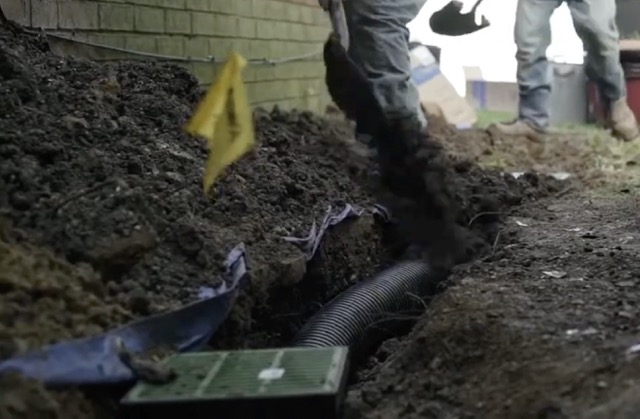
On flooded properties, it is necessary to equip a drainage system. Once you put in the effort, you will get rid of the annual disaster. First, assess the slope of the land. It’s easier if the land slopes toward a roadside ditch. In this case, you just need to dig a ditch along the fence at least 1 meter deep, leading into the ditch. If the land has no slope, or if the slope goes in the opposite direction, it will be more difficult to arrange a drainage system — a system of ditches will work better.The easiest way is to arrange a brick drainage. For this, dig a ditch at least 50 cm wide and at least 1 meter deep. It should be filled with broken bricks, covered with gravel on top, and the top layer should be fertile soil. A soft drainage system is more difficult to arrange. However, it has a great advantage — such a drainage system will not need to be cleaned later. To equip it:
Dig a trench with a rounded bottom.
Lay landscaping fabric or another non-woven waterproofing material on it.
Place some drainage pipe (weeping tile) on top.
Fill two-thirds of the trench depth with gravel and wrap it with landscaping fabric. Then cover the ditch with sand and fertile soil.
Landscaping fabric will prevent soil from entering the drainage layer, meaning the system will not clog and stop functioning. By arranging such a drainage system once, you will no longer have to deal with cleaning the drainage system, and the flooding will stop because now the water has a clear path to leave the land.