Getting your sprinkler system ready for spring 2026 will help you water more efficiently, stop leakages, and save money on repairs. After the winter closure, a correct spring start-up will bring back water pressure, keep the plant’s parts safe, and make the watering schedule more productive for green lawns and plants when the weather is getting warmer.
When Is the Best Time to Turn On a Sprinkler System in Spring 2026?
The ideal time to activate a sprinkler system in spring 2026 is once the possibility of a hard frost has gone and the temperature during the day stays steadily above 10°C (50°F). In most regions of Ontario and the GTA, this usually happens sometime between late March and mid-April, and the majority of the systems could be safely started from April 5 to April 20, 2026, depending upon the weather.
Before turning on the system, the temperature at night should stay above 0°C (32°F) for at least 7–10 days in a row. Starting the system too soon may result in frozen pipes, broken fittings, and damaged valves if the temperature falls overnight. The best time of the day for a spring start-up is from late morning to early afternoon (10:00 AM–2:00 PM) when it is warmest and the water pressure is constant.
After switching it on, the watering should only be minimal in the early spring. In April, lawns generally need about 10–15 mm (0.4–0.6 inches) of water per week, combining the watering and rainfall. Watering at the right time can avoid injury, save water and promote a healthy growing season.
How to prepare sprinkler system for spring in 2026?
Spring Sprinkler Start-Up Checklist: Step-by-Step Guide
Step
Task
What to Check / Do
1
Confirm safe temperatures
Daytime above 10°C (50°F) and nighttime above 0°C (32°F) for 7–10 days
Even small leaks can waste hundreds of litres per week
10
Set spring watering schedule
Start with 10–15 mm (0.4–0.6 in) per week, including rainfall
How to prepare sprinkler system for spring in 2026?
Common Problems Found During Spring Irrigation Inspections
Spring irrigation inspections often unveil issues that have been caused by freezing temperatures, ground movements, and system inactivity during winter. One of the most commonly encountered problems is the pipes that are cracked or leaking and this is generally the outcome of residual water freezing inside the lines. Besides that, broken sprinkler heads and misaligned nozzles are common problems as well, and they are usually the result of snow load, foot traffic, or lawn equipment. In some cases, faulty valves may remain open or be incapable of activating due to the presence of a solenoid that is damaged or debris; in such cases, zones that will not shut off can be expected. It is also common for the controller to lose its programming during the winter power outages and, as a result, the watering cycles may be skipped or the run times may be incorrect. Backflow preventers constitute a further essential inspection point since freeze damage may lead to concealed leaks and code violations. In case these problems are ignored, the water consumption may rise by 20–40% and the cost of repairs of the landscape or foundation may become exorbitant. Identification of the problems at an early stage through spring inspections is instrumental in avoiding emergency repairs and hence, the watering system can run smoothly for a whole season.
Spring Irrigation Inspection Issues & Solutions
Issue Found
Repair Solution
Typical Cost (CAD)
Cracked or leaking pipe
Replace damaged pipe section
$25 – $150
Broken sprinkler head
Replace head and adjust height
$65 – $130
Valve not opening/closing
Clean or replace solenoid/valve
$95 – $120
Controller not programmed
Reprogram and test zones
included in start-up fee
Backflow preventer damage
Repair or replace assembly
$200 – $450
Overspray or misting
Adjust or replace nozzle
$15
How to prepare sprinkler system for spring in 2026?
How Winter Freezing Affects Sprinkler Pipes and Valves
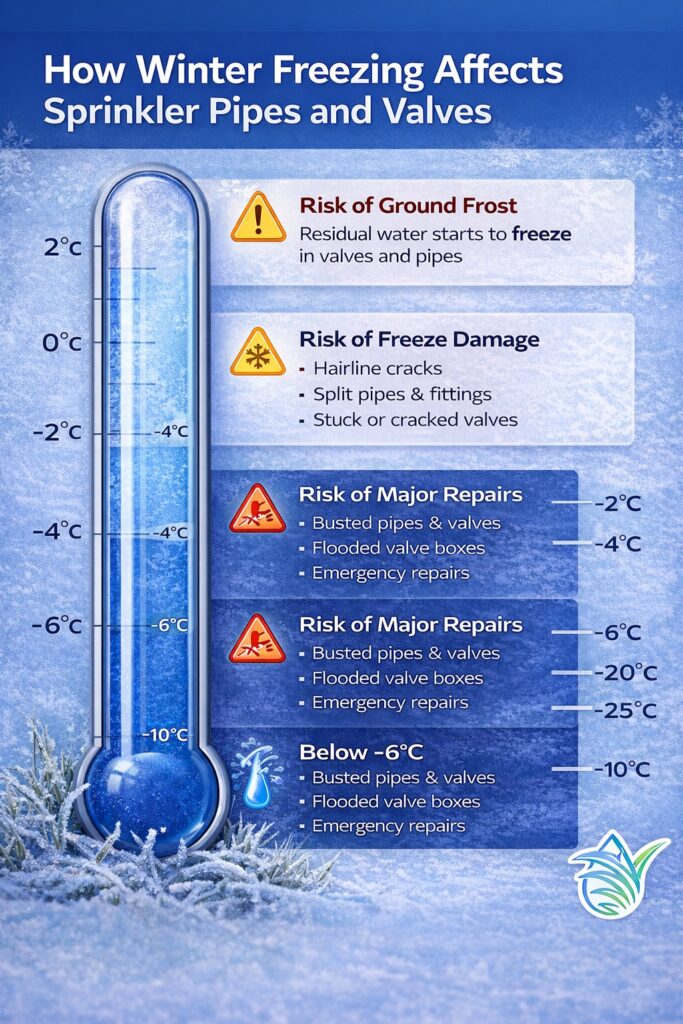
Winter freezing is a major cause of damage to sprinkler pipes and valves from water that is left in the system. At temperatures below 0°C (32°F), water frozen in an enclosed space will expand by around 9%, resulting in pressure build-up in pipes, fittings, and valves. Such pressure may cause hairline cracks, splitting of PVC or poly pipes, and damage to fittings that may not be noticed until the following spring season.
Irrigation valves are most at risk as they have internal chambers and diaphragms that hold water. Freeze damage may cause a valve to remain open, not close fully, or continue to leak after the system is reactivated. Damage may also occur to systems that have been properly winterized due to ground movement as a result of frost heaving which displaces pipes and causes stress on joints. At the onset of spring, these problems may manifest as a sudden loss of pressure, flooding of valve boxes, or uneven sprinkler distribution. Promptly addressing freeze-related damage will save water, prevent landscape erosion, and avoid the high costs of emergency repairs during the peak of irrigation season.
How to prepare sprinkler system for spring in 2026?
Signs Your Sprinkler System Was Damaged Over Winter
One of the most frequent reasons for sprinkler system breakdowns in spring, is cold weather freeze damage. Water expands by approximately 9% when it freezes, thus the pressure can be so high which leads to cracking of pipes, valves, and fittings. A case can happen that even a system that was winterized gets damaged due to frost heave and ground movement.
Common Signs of Winter Damage
Sudden drop in water pressure When a sudden drop in pressure can be felt through several zones, it is a sure sign of underground cracked mainlines or lateral pipes.
Water pooling or soggy soil If there is water standing around sprinkler heads or valve boxes, it most likely means there are leaking pipes or split fittings underground.
Sprinkler heads not popping up or leaking Damage from a freeze tends to result in cracked risers and seals, which are the main reasons for constant leaks or poor spray performance.
Zones not turning on or shutting off If the valves or solenoids of the area are damaged, the zones will not operate properly and this leads to flooding of certain areas and others becoming too dry.
Air sputtering or excessive misting When lines are broken, they can suck in the air and this will reduce the efficiency of the system and the amount of water wasted will be increased by 20–40%.
Higher-than-normal water bills Underground leaks that are small can still waste as much as 1,000–3,000 litres of water per day when the system is operating.
How to Adjust Sprinkler Run Times for Spring Weather
It is quite important to change sprinkler run times in accordance with the spring weather in order to not only prevent overwatering but also to save water as the temperature and rainfall go up.
Generally, lawns in early spring need between 30-50% less water than at the height of the summer if only because evaporation rates are lower and there is more soil moisture. As a rough estimate, spring turf grass needs about 10–15 mm (0.4–0.6 inches) of water per week with rainfall considered.
Initially, lower your controller’s seasonal adjustment to 50–70% of the summer settings. Instead of watering your lawn daily, watering two to three times per week will allow soil to dry a little between watering cycles, thus encouraging deeper root growth. Sprinklers should preferably be run in the early morning, anytime between 4:00 and 8:00 AM, when wind and evaporation are at their lowest. Do not water at night since moisture retained overnight might lead to the growth of fungal diseases. As the days get warmer (above 20°C/68°F) and rainfall less frequent, you can incrementally increase your watering schedule.
How Much Water Lawns Need in Early Spring vs Summer
It is well-known that lawns in early spring need far less water than in summer, largely because of the lower air temperature, decreased evapotranspiration, and more soil moisture available from nature. During early spring (March-April), a healthy lawn can get by with a total of about 10–15mm (0.4-0.6 inches) of water per week i.e. rainfall plus watering. That roughly translates to watering a lawn 1-2 times per week or if it rains enough – sometimes not watering at all.
In fact, in summer (June-August), after lawns have been exposed to heat and drying up of moisture, in order for them to stay healthy, they will be in need of extra water to the tune of 25-40 mm (1-1.5 inches) per week. Consequently, the watering turns into 2-4 times per week, depending on the soil type and the kind of grass. Sandy soils are generally more in need of short, frequent watering cycles, whereas clay soils, whose particles hold water tightly, will be wet for a longer time.
Bringing too much water to the soil’s surface in the spring may cause roots to only develop in the upper layer of the soil, and also make the lawn susceptible to fungi and the whole unnecessary use of water. Making your watering schedule reflect the different seasons can not only save you 30-50% of water but it can also be the best way of getting deeper root systems and a healthier lawn throughout the season.
How Smart Controllers Optimize Spring Watering Schedules
Smart irrigation controllers will adjust watering schedules in the spring automatically with the weather and season to save water. These controllers can detect temperature, rainfall, humidity, and evapotranspiration (ET) data in the sensor/local environment, and calculate the amount of water their landscapes really require. They can even help reduce watering by 30–50% compared to fixed schedules, as spring is a season when the weather is cooler and rainy more often.
Among their features, smart controllers can shut off watering right after rainfall (several millimeters) and besides that, they can even delay cycles during frost nights. Using the seasonal adjustment function, they will gradually reduce the summer programme to 50–70% in early spring after the vacation period, thus removing the need for guessing. It is also possible to schedule each zone separately so that turf, flower beds, and drip irrigation are given the right amount of water. You can also get notifications about leaks or excessive flow remotely which is very useful in case of your absence. In general, you can expect several good outcomes from your smart controller, such as better water usage, landscape protection, and lower water bills both during the spring and throughout the year with variable weather.
How to Clean and Adjust Sprinkler Heads After Winter
After winter, cleaning and adjusting sprinkler heads are crucial steps if you want to get your irrigation system back to its optimal function. First, switch on your system zone by zone and walk around each sprinkler head to conduct a visual inspection. Dirt, grass or any other debris from the winter can find their way into the sprinkler nozzle. Unscrew the nozzle and wash it under a tap; a blocked nozzle can result in the coverage area being reduced by 20-30%.
Then, make sure each sprinkler head is flush with the ground. The phenomenon called frost heave normally causes heads to tilt or go down, thus leading to uneven spray and water wastage. Correct any misaligned heads and make them level with the ground in order to get the right spray patterns. Change the arc and radius so that the water gets to the plants evenly without any water being wasted on the sidewalks, buildings, or driveways. Just a little bit of water going out of the designated area can lead to hundreds of liters of water being wasted every week.
Also, don’t hesitate to get new heads if the old ones are cracked or broken. Sprinkler heads when properly cleaned and adjusted can help to conserve water, nourish plants and make your irrigation system trustworthy during spring and summer seasons.
Why Valve Boxes and Backflow Preventers Should Be Checked in Spring
Valve boxes and backflow preventers are among the most essential components to any irrigation system and should be a priority for inspection during spring start-up. Freezing temperatures and frost heave over winter can cause damaged valves, broken fittings, and worn-out seals. Moreover, valve boxes usually get filled with soil, debris, or suffer from waterlogging, which leads to rusting of the wiring connections and valves failing to open or close properly. A single valve failure could result in the loss of thousands of liters of water in no time.
Backflow preventers are undoubtedly the most crucial devices as they safeguard the drinking water supply from contamination.
Freeze damage to a backflow device may be hidden at first but can cause leaks, pressure drops, or failure of the device during mandatory testing. Local governments may impose fines or shut off the water service for damaged or non-compliant backflow preventers. A thorough inspection and servicing of these parts in the spring will guarantee safety of the operation, will prevent wastage of water and will ensure that the irrigation system remains compliant and dependable throughout the watering season.
Should You Replace Old Nozzles Before the New Season Starts?
Before the new irrigation season, replacing old sprinkler nozzles can be a wise and cost-effective move. Due to sediment, mineral buildup, and regular operation, nozzles gradually deteriorate, leading to a 20–40% reduction in water distribution uniformity. A damaged or malfunctioning nozzle can cause misting, overspray, and dry spots, thus increasing water bills and causing turf to become stressed.
High-efficiency nozzles are engineered to produce more uniform spray patterns and better pressure regulation. In fact, it is often possible to save up to 30% of water just by upgrading to new nozzles without altering the irrigation schedule. Replacing nozzles in spring is most advantageous as the system undergoes inspection and adjustment after winter anyway. The expense incurred from replacing nozzles is minimal when weighed against the saving of water and less frequent system wear over time. By upgrading before the season, you ensure even coverage, healthy landscapes, and an efficient irrigation system throughout the year.
Our Partner How to prepare sprinkler system for spring in 2026?